


How to see which AI bots visit your WordPress site
You can't see AI bots in Google Analytics, but you can see them in your server's access logs or with a WordPress plugin that counts them. Both show which AI crawlers read which pages, and how often. This guide covers both routes, explains what each bot is for, and says what to do with what you find.
A crawler (or bot) is a program that fetches web pages automatically. GPTBot, for example, is the crawler OpenAI sends to collect pages for training its models.
Why don't AI bots show up in Google Analytics?
Google Analytics counts visitors by running a small script in their browser. Crawlers fetch your page's HTML and leave without running that script, so they never appear in your reports.
The visits still happen. Your web server answers every one of them, and that's where you can count them.
Which AI bots visit WordPress sites, and what is each one for?
Each AI company runs several bots, and they do different jobs. Some collect pages to train models. Some build the index an AI searches when it answers a question. Some fetch one page because a person just asked about it. The job matters more than the name, because it decides what you lose if you block the bot.
| Bot | Company | What It Does | If You Block It |
|---|---|---|---|
| GPTBot | OpenAI | Collects pages to train models | Your pages aren't used for training. ChatGPT search isn't affected. |
| OAI-SearchBot | OpenAI | Builds the index for ChatGPT search | OpenAI says your site won't be shown in ChatGPT search answers. |
| ChatGPT-User | OpenAI | Fetches a page when someone in ChatGPT asks for it | OpenAI says robots.txt rules may not apply, because a person started the visit. |
| ClaudeBot | Anthropic | Collects pages to train models | Your pages aren't used for training. |
| Claude-SearchBot | Anthropic | Indexes pages to improve Claude's search results | Anthropic says your site may be less visible in Claude's search results. |
| Claude-User | Anthropic | Fetches a page when someone in Claude asks for it | Claude can't read your page for that person. |
| PerplexityBot | Perplexity | Finds and links websites in Perplexity's search results. Perplexity says it isn't used for training. | Perplexity is less likely to show and link your pages. |
| Perplexity-User | Perplexity | Fetches a page when someone in Perplexity asks for it | Perplexity says it generally ignores robots.txt, because a person started the visit. |
| Googlebot | Crawls for Google Search, including AI Overviews and AI Mode | You disappear from Google Search too. Don't block it. | |
| Applebot | Apple | Crawls for search in Siri, Spotlight and Safari | You disappear from Apple's search features. |
| Meta-ExternalAgent | Meta | Collects pages to train Meta's AI models and to index content for its products | Your pages aren't used for training. |
| Meta-WebIndexer | Meta | Indexes pages so Meta AI can cite and link them | Meta AI is less likely to cite and link your pages. |
| CCBot | Common Crawl | Builds a free public archive of the web that many AI companies train on | Your pages drop out of future archives. |
The bot names and their jobs come from each company's own crawler page, checked on 4 November 2026. Companies add and rename bots often: OpenAI's page now lists OAI-AdsBot, which checks pages submitted as ChatGPT ads.
Two names you may read about never show up as visitors. Google-Extended and Applebot-Extended aren't crawlers. They're names you can use in robots.txt to tell Google or Apple not to use pages their normal crawler already fetched for training. Blocking Google-Extended doesn't affect whether you appear in Google Search.
How do you check your server logs for AI bots?
Your server keeps an access log: one line for every request, including the visitor's user agent, the name a browser or bot gives for itself. Every bot in the table puts its name in its user agent, so you can count them by searching the log for those names.
Most hosts let you download the raw access log from the hosting control panel. On cPanel it's under Metrics, then Raw Access. If you can use a terminal, this counts the visits from each AI bot in a log file called access.log:
grep -oiE "GPTBot|OAI-SearchBot|ChatGPT-User|\
ClaudeBot|Claude-SearchBot|Claude-User|\
PerplexityBot|Perplexity-User|\
Meta-ExternalAgent|Meta-WebIndexer|\
Applebot|CCBot" access.log \
  | sort | uniq -c | sort -rn
The log route is free and complete, but it's a chore. Many hosts keep only a few days of logs, and you have to repeat the search every time you want to look. Some managed WordPress hosts don't give you raw logs at all.
How do you track AI bots in WordPress with a plugin?
A plugin can count AI bots as they arrive, so you don't have to fetch logs. We built one: Referenced – AI Crawler Tracking. The plugin is free on WordPress.org and reports to a Referenced account, which starts with a 7-day free trial. It recognises more than 20 AI and search crawlers, including every bot in the table that visits sites.
Setting it up takes three steps:
- In WordPress, go to Plugins, then Add New, search for "Referenced AI Crawler Tracking", then install and activate it.
- In your Referenced account, open Settings, then Connections, and create a WordPress token.
- Back in WordPress, open Settings, then Referenced, and paste the token.
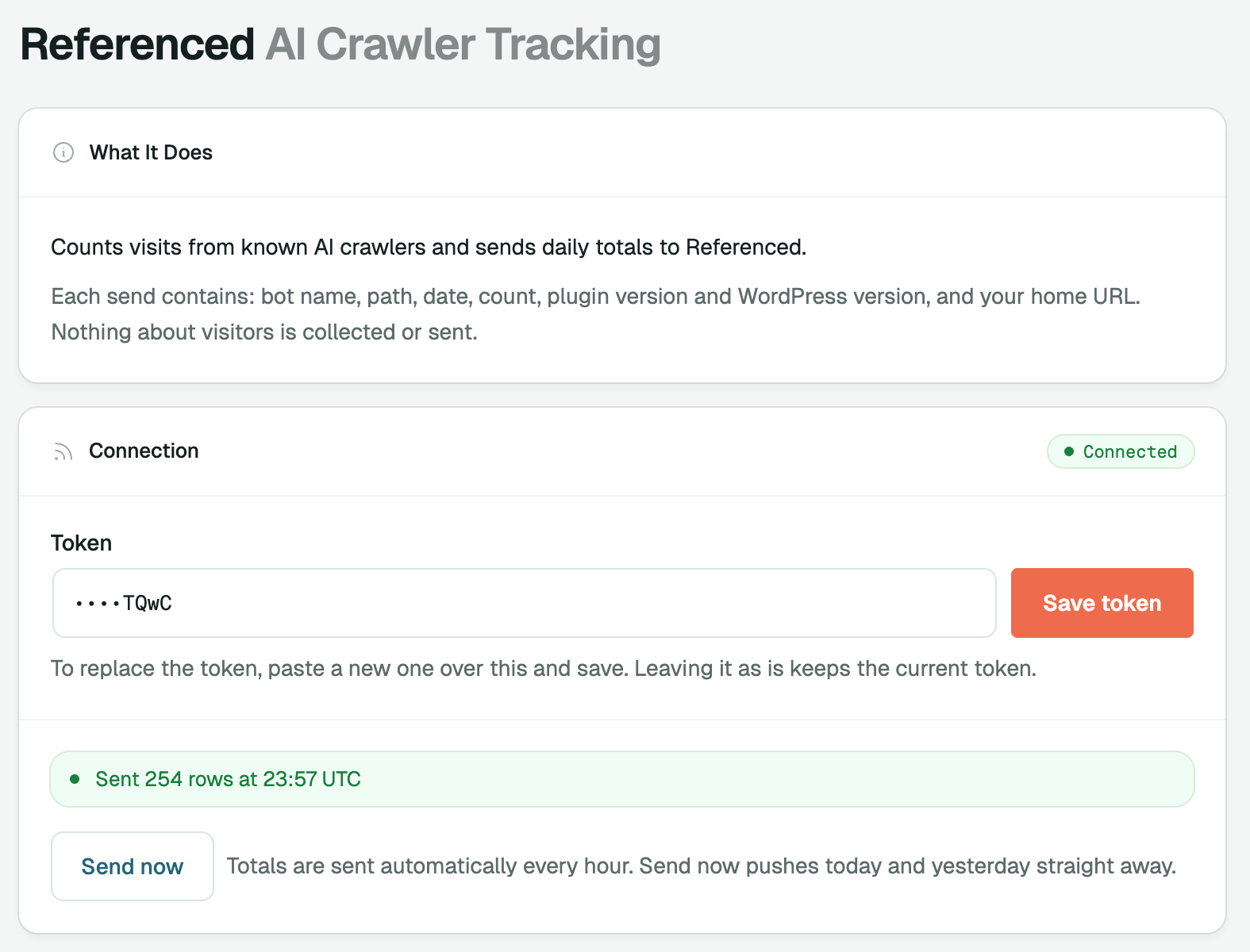
The plugin sends totals every hour, and the first report arrives within about an hour of your site's next visits. The "Send now" button sends at once. Your WordPress dashboard then shows each crawler's visits for the last 7 days, and Referenced shows which pages each one read over the last 30 days.
The plugin records no visitor data: no IP addresses, no cookies, nothing about people. For each known bot it keeps one number per page per day. It sends only the bot name, the page path, the date, the count, the plugin and WordPress versions, and your site's address. It changes nothing on your pages.
You don't have to take our word for that. The plugin is open source under the GPL, and the code is on GitHub. Issues and pull requests are welcome.
What did we see on one WordPress site?
On a WordPress travel blog that uses our plugin, 19 different crawlers made 627 visits in its first week. One bot made almost half of them: Meta-ExternalAgent, Meta's training crawler, visited 289 times and read 125 different pages.
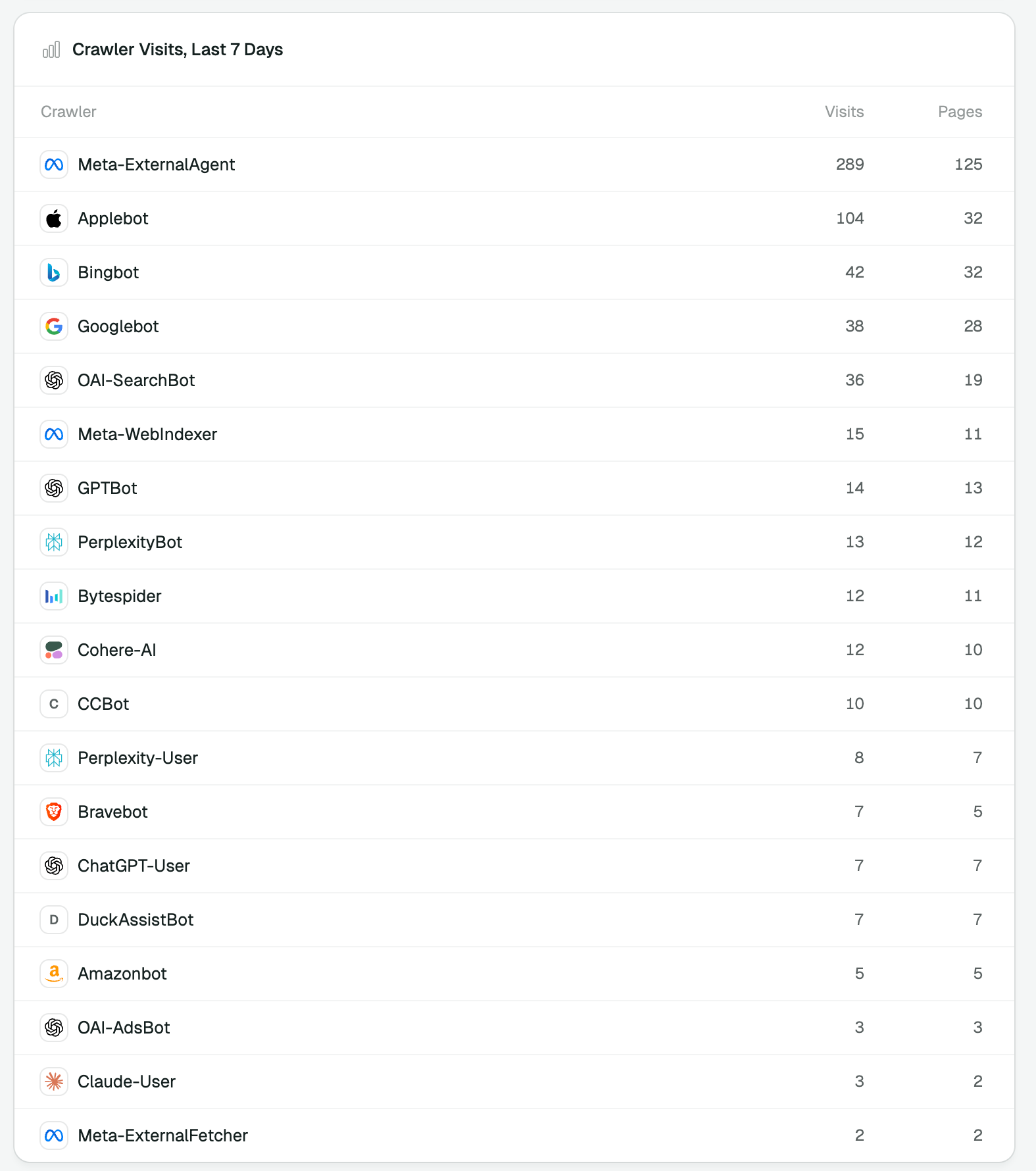
The bots that decide whether the site can appear in AI answers visited far less. OAI-SearchBot, which builds ChatGPT's search index, visited 36 times across 19 pages. PerplexityBot visited 13 times.
The visits that matter most were the rarest. ChatGPT-User, Perplexity-User, Claude-User and Meta-ExternalFetcher made 20 visits between them. Each of those is a person asking an AI a question, and the AI opening one of the site's pages to answer it.
Anthropic's training and search crawlers didn't visit at all that week.
How we measured this: one WordPress site in its first seven days on our plugin, up to 4 November 2026, 627 visits in total. Its owner agreed to us sharing the numbers. It's one site, so read it as an example, not a benchmark. Pages served from the site's cache weren't counted (see below), so the real numbers are higher.
What should you do with the numbers?
Start with the search bots: OAI-SearchBot, Claude-SearchBot, PerplexityBot, Meta-WebIndexer and Googlebot. If one of them never visits in a month, something is probably stopping it. Check your robots.txt first. Then check your security plugin, firewall or CDN, which can block a bot even when robots.txt allows it.
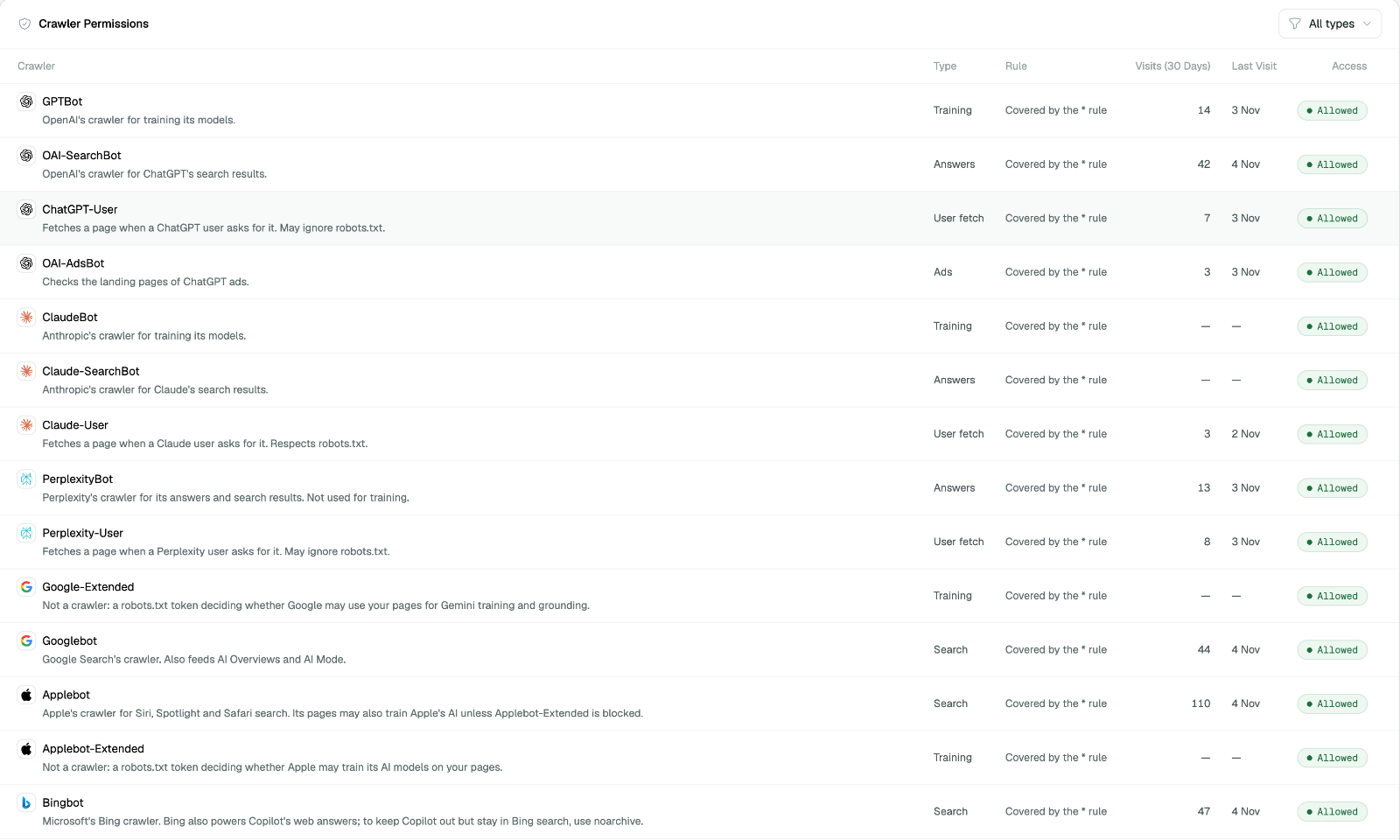
The AI Access page in Referenced for the same travel blog on 4 November 2026. The plugin had been connected for about a week, so the 30-day column covers that week. Claude-SearchBot is allowed but hasn't visited once.
Next, compare the pages bots read with the pages you care about. If your pricing or product pages never get a visit from a search bot, AI answers can't quote them. Our guide to how ChatGPT picks its sources covers what makes a page worth fetching.
Then watch the user-triggered visits (ChatGPT-User, Claude-User, Perplexity-User). A page that keeps getting them is one people are asking AI about. That's worth knowing even if you never see the answer.
Finally, decide on training bots on their own terms. Blocking GPTBot, ClaudeBot or Meta-ExternalAgent keeps your pages out of training. OpenAI runs GPTBot separately from OAI-SearchBot, so blocking GPTBot doesn't take you out of ChatGPT search. Whether that trade is worth it is your call.
A visit isn't a mention. A bot reading your page doesn't mean an AI will recommend you, or even cite you. Our post on what a citation in an AI answer tells you covers that gap. Referenced puts both sides together: which bots read your pages on its AI Access page, and whether ChatGPT, Google AI Overviews and Perplexity actually mention you.
What can't a plugin see?
A WordPress plugin only sees requests that reach WordPress. Most WordPress sites use a page cache, such as WP Rocket, LiteSpeed Cache or caching built into the host, or Cloudflare. A cached page is sent without running WordPress at all, so the plugin never counts that visit. The same goes for images and PDFs. So the plugin's numbers are a floor: the real number of visits is at least that high, and often higher. Your server logs or your CDN's dashboard can show the visits the cache answered.
A user agent can also be faked. Anyone can send a request that calls itself GPTBot. OpenAI publishes the IP addresses its bots use (for example, GPTBot's), and Perplexity, Apple and Common Crawl do the same on their crawler pages. If a "GPTBot" visit comes from an address outside OpenAI's list, it isn't GPTBot.
If you only do one thing after reading this, check that OAI-SearchBot, Claude-SearchBot, PerplexityBot and Googlebot can read your most important pages.

Contents
Keep reading
← All articles
GEO reporting: how to report AI visibility to clients
How to put AI visibility in a monthly client report without over-claiming, what to say when the number moves for no reason, and how to show traffic honestly.
Read →
AI visibility audit: start by reading one answer
Before you track anything, read one AI answer properly. A step-by-step check you can do in half an hour, and what to look for at each step.
Read →
Prompt tracking: why your first prompt list is wrong
Everyone starts by tracking the prompts they wish customers asked. Here's how to find the ones they actually do, with a starter list you can copy.
Read →How visible is your brand in AI answers?
Tell us your domain and we'll send you a visibility report. Free, no card.